
I’ve been selling clothes lately as a side hustle. Thrifted finds, old collections, vintage jackets, and purses I should probably keep but list anyway – mostly because Nelnet doesn’t accept “good vibes” as legal tender. So here I am, digging through racks of dead people’s blouses to pay off a $50k journalism degree.
Honestly? It tracks.
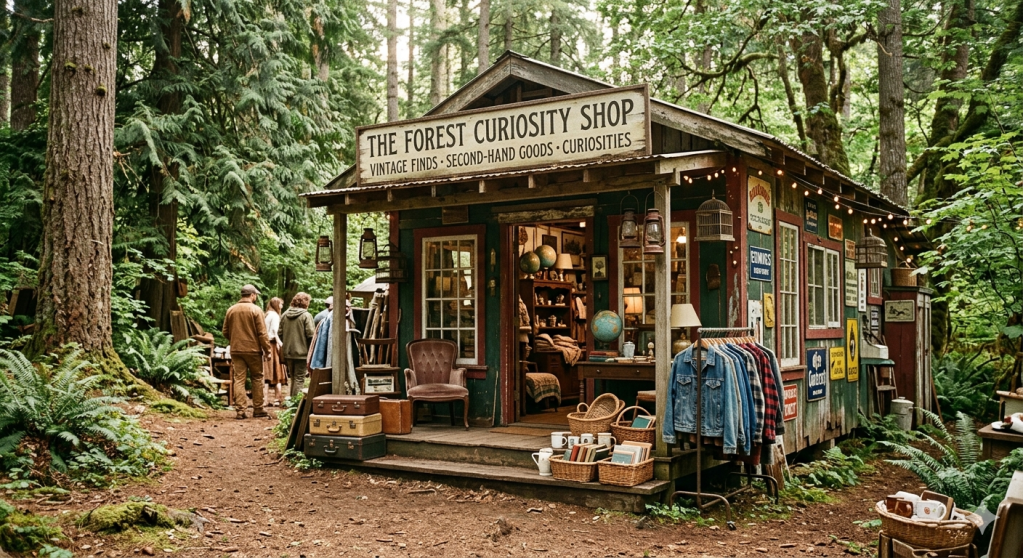
I think a lot about why I’m so drawn to other people’s old things. I didn’t grow up without; I grew up emotionally unattended. Big difference. As an only child most of the time, I was the sole kid orbiting around distracted Boomers who were dealing with their own private storms. I had clothes. I had a karaoke machine. We had a Schwan’s man. I also had enough unsupervised freedom to sneak out of my bedroom window, disappear to parties all night, and stroll back in at sunrise without a single soul noticing I was gone. I was a total latchkey kid, fueled by flavored Dr. Pepper lip gloss and Delia’s catalogs.
When you grow up in a sizeable, blended step-family and someone passes away, possessions become a quiet ranking system of importance. The meaningful jewelry gets claimed immediately. The heirlooms disappear into predetermined hands. Then comes the second wave: the boxes nobody really wants, but nobody has the stomach to throw away, either.
That’s usually where I came in. You take it politely, of course, because rejecting a dead person’s Tupperware feels vaguely cursed.
Family death has this weird, frantic garage-sale energy. Everybody suddenly becomes deeply invested in objects. Jewelry gets quiet. Furniture gets political. Relatives who haven’t called you in four years will suddenly fight to the death over a chipped casserole dish or an antique lamp. It’s grief, wrapped in a touch of late-stage capitalism.
Maybe that’s why I love thrifting so much. When other people’s discarded things end up in my hands, I wonder about them constantly. Why didn’t the family keep this perfect, worn leather purse? Why did nobody want this tiny velvet bag with the broken clasp? Why does this old jacket still smell faintly of Marlboro Lights and Liz Claiborne perfume?
Maybe nobody cared. Maybe everybody already had too much. Or maybe objects only become meaningful once enough time passes around them.
I don’t know. What I do know is that I’ve inherited bad advice, avoidance, complicated family dynamics, and enough emotional confusion to qualify as a personality trait. But I also inherited curiosity.
I love the dopamine hit of a good find—the rare jacket hidden between the polyester nightmares at Goodwill. It’s a tiny adrenaline rush when you realize something beautiful almost got thrown away, but somehow ended up in your rickety plastic cart. Every vintage item is a temporary fantasy. I picture the outfit, the restaurant, the road trip. I envision a version of myself carrying it into some dramatic life moment while Stevie Nicks plays in the background—a version of me who inexplicably owns a red-and-black striped 1972 Chevy El Camino and total emotional maturity.
Then I list it on Depop for $50.
My husband has a similar eye for resurrection, though his medium is furniture. He’ll spot some tragic-looking dresser on Facebook Marketplace, and a week later, someone is paying him triple for it. Honestly, if society collapses, he’ll survive the apocalypse by bartering restored mid-century side tables for propane and T-bone steaks.
We are hoarders of potential, which makes our new life on this farm a bit ironic. Out here, life moves at the speed of North Carolina clay.
I catastrophically underestimated the trees on this property. You look at wooded land online and think: Wow. Peaceful. Magical. Rustic. Then you move in and realize the trees are running a hostile government operation. We need to clear about a hundred of them just to get a single sliver of sunlight into the garden. Every project breeds three more projects.
But lately, the woods have started introducing themselves to us.
A fox trots through the backyard like he pays property taxes here. He looks exactly like Fantastic Mr. Fox, right down to the suspicious little face and rich-guy confidence. Deer visit in families, standing strangely close to Luma and me, looking at us like they recognize another exhausted mother just trying to keep everyone alive. Tiny turtles and massive, prehistoric-looking snappers drag themselves across the road daily; the lucky ones make it. A bright red cardinal hangs around the porch like an old Italian relative supervising everybody’s decisions, while the neighbor’s young Lab comes over daily to play with Millie, our Goldendoodle.
I live in what feels like a treehouse now. The branches face the window and shout, “This is a stick-up!” Birds scream their gorgeous little songs before sunrise like tiny, unpaid opera singers.
The forest is never quiet except in the winter. It breathes. It watches. It explodes with life underneath every rock, every fallen branch, and every pile of wet leaves slowly cooking in the Carolina heat. Moving here taught me that silence doesn’t actually exist.
Like the racks at Goodwill, or the boxes of leftover grief from a family passing, the woods are just another crowded room full of old history waiting to be sorted through.
There’s always something growing.
There’s always something rotting.
There’s always something trying to come back to life.

