
I really thought I’d roll into North Carolina, toss on a straw hat, and by Tuesday be bottle-feeding a micro-cow named Clementine.
That was a full Pisces fever dream.
For those wondering why I can so easily romanticize an entire agrarian lifestyle before I’ve even unpacked the coffee maker. Pisces energy is ruled by Neptune, planet of imagination, illusion, and “sure, I can absolutely run a farm, write a novel, and churn butter before lunch.” It’s the sign of the dreamer. Boundaries blur. Reality is… flexible. It’s beautiful. It’s delusional. It’s both.
I’ve lived inside my own cinematic trailer for most of my life.
Cue North Carolina: land of humidity, hardwood forests, and a very real real estate market.
Instead of instant farmstead glory, it’s been weeks of driving, mapping school routes, calculating soccer commute times, and asking myself very serious questions like:
Would I spiritually thrive in the county… or would I wither into a woman talking exclusively to chickens?
There’s a line for me. I want goats and garden beds. I also want coffee shops and a nice ass restaurant within a reasonable radius. I don’t want to need a GPS and a protein bar just to get to town.
And yet…
There’s something about being here that feels different. Not just North Carolina. People, in general. There’s a softness. A steadiness. Strangers make eye contact. They hold doors. They ask questions and wait for the answers. It feels less performative. More human.
At night, when the woods go black and the cicadas hum like some Southern white-noise machine, I get this oddly comforting feeling knowing wild things are moving out there. Owls. Deer. Something rustling that I probably don’t want to identify.
Except the morning my husband and son opened the front door and locked eyes with an entire pack of coyotes.
Glowing eyes. Still bodies. Staring.
And then – gone. Dissolved into the trees like ghosts.
That part felt very “welcome to the forest, ma’am.”
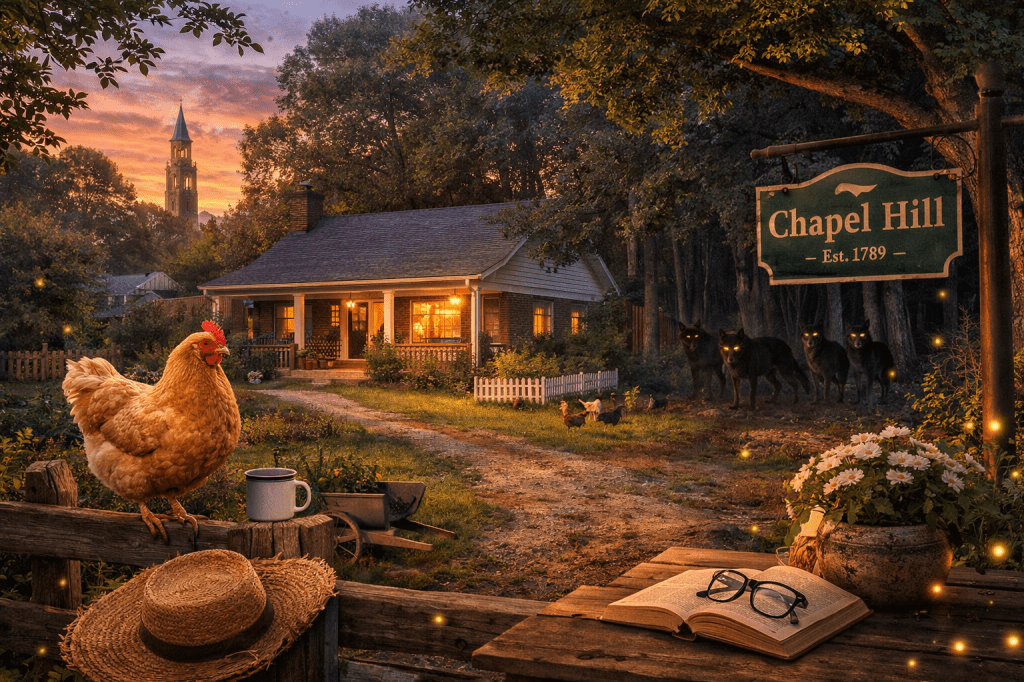
We ended up buying a 1976 Chapel Hill-style home on an acre I absolutely LOVE.. We could’ve gone big. I’m talking 25 acres big. But here’s the truth: it was never the land that felt off. It was the house sitting on it. Or the 40-minute drive to civilization. Or the way I couldn’t picture us living there beyond the fantasy version of ourselves.
So we chose one acre. Close to UNC. Close to life.
And Chapel Hill? It has this understated confidence. It’s not flashy. It doesn’t scream. It’s a university town built around the University of North Carolina, founded in 1789, the first public university in the United States to open its doors. There’s history baked into the brick paths. You can feel it walking down Franklin Street – bookstores, old bars, professors on bikes, students arguing about philosophy over coffee.
It’s progressive but Southern. Intellectual but unpretentious. You’ll see someone in pearls next to someone in Birkenstocks next to someone in Tar Heel blue from head to toe. Basketball here isn’t a sport -it’s a religion.
It’s leafy. Like aggressively leafy. Giant hardwoods arch over streets. In spring everything blooms at once like the town collectively decided to show off. It feels established. Rooted. Quietly powerful.
There’s a calm here. A groundedness I didn’t expect.
Maybe I didn’t need 25 acres. I can’t handle 25 acres!
Maybe I just needed enough land to plant something real without losing myself in the woods.
I haven’t written for seven months.
That’s how long it took me to adapt. And if you know me, you know that’s not a casual gap. Writing is how I metabolize change. It’s how I stay awake in my own life. When the words stopped, I should have known something bigger was happening.
Moving away from the desert sent my system into shock.
Not dramatic. Not loud. Just quiet internal disorientation.
Arizona raised me. The sharp light. The cactus silhouettes at sunset. The way the mountains glow like they’re on fire at 7 p.m. I knew how to breathe there. I knew the rhythm of that dryness. The dust felt like home.
It was the color palette of my adulthood. It was sharp light and long horizons and heat that forced you to slow down. The desert doesn’t crowd you. It gives you space. It lets you see for miles. I didn’t realize how much I relied on that openness until I traded it for trees that close in overhead like a cathedral.
And then I left.
North Carolina felt alive in a way that almost overwhelmed me at first. Green on green on green. Different people. SLOWER. Forest instead of skyline. I felt like I’d lost my horizon.
And somewhere in that transition, I died a little.
Not physically. Not tragically. Just identity-wise. The version of me that knew exactly how to exist in the desert dissolved. Desert Girl didn’t come with me intact. She evaporated somewhere between cactus and oak tree.
I went quiet.
But here’s what I didn’t expect.
North Carolina loved me anyway.
It didn’t rush me. It didn’t demand I perform happiness. It just existed around me – steady, rooted, patient. The people. The trees. The rhythm of this place. It softened the shock. It lessened the blow. It held me while I recalibrated.
And slowly, almost without announcement, I came back alive.
The words started whispering again. Not in a dramatic monologue. Just a nudge. A sentence. A feeling. A recognition that I wasn’t broken. I was transitioning.
You can grieve a landscape.
You can grieve a version of yourself.
And you can still be deeply grateful for where you land.
Seven months silent.
Not as the same woman who left the desert.
But as someone expanded by it and revived by what she found here.
Now ask me again in six months when I’ve named the deer and installed a chicken coop.
 Slangshot